My Full Gear List for Fastpacking the Tour du Mont Blanc in 5 Days

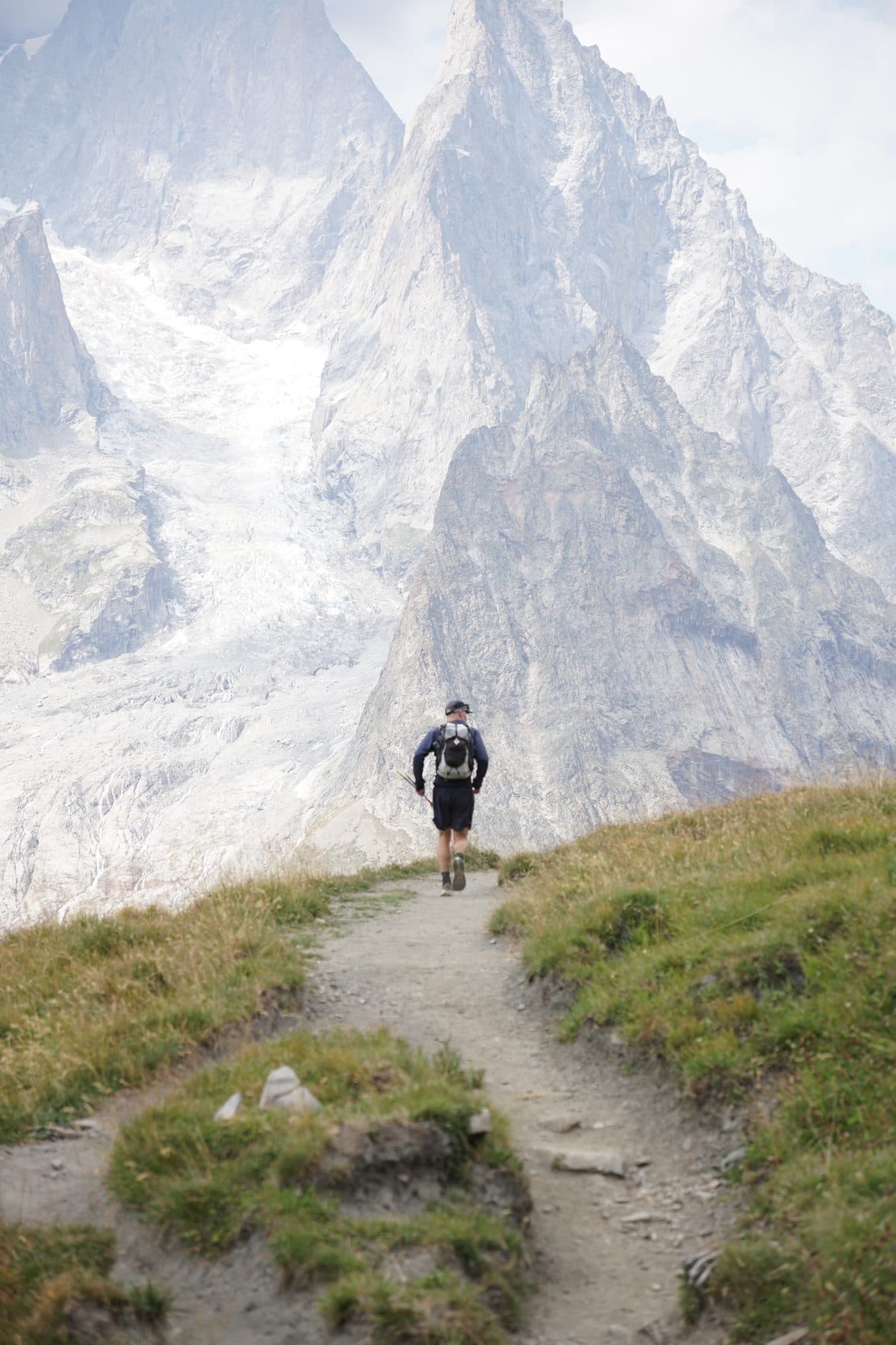
We ran the Tour du Mont Blanc in 5 days. That worked out to roughly 30km and 2000m of vert per day, sleeping in refugios and huts each night rather than carrying a tent.
That format changes everything about what you pack. No tent, no sleeping bag, no stove. You're carrying a running pack, not a hiking pack, and every item has to survive the test of being on your back for six or seven hours of climbing and descending.
Here's exactly what I took, why each thing earned its place, and the handful of items I'd leave at home if I did it again.
Storage
How big a pack do you need to fastpack the TMB in 5 days?
Smaller than you think, but not as small as I'd hoped.
I used a Black Diamond Distance 22 for the whole 5 days and 4 nights. It was honestly pushing the limits. Everything fit, but there was no spare room and no elegant way to get to the things buried at the bottom.
So I added a 2L Raide Research belt for extra space. That took the pressure off the pack and gave me somewhere to keep the stuff I needed to reach without stopping: flasks, snacks, phone.
- Black Diamond Distance 22L pack. Big enough for 5 days if you're disciplined. It runs well, which matters more than capacity when you're descending for an hour.
- 2L Raide Research belt. The overflow. Also solved the "I need that thing right now" problem that a running vest creates.
- 3x dry bags. Clothes, sleeping stuff, electronics. It rains in the Alps. More importantly, dry bags force you to organise, which means you actually find things instead of emptying the pack onto a refugio floor.
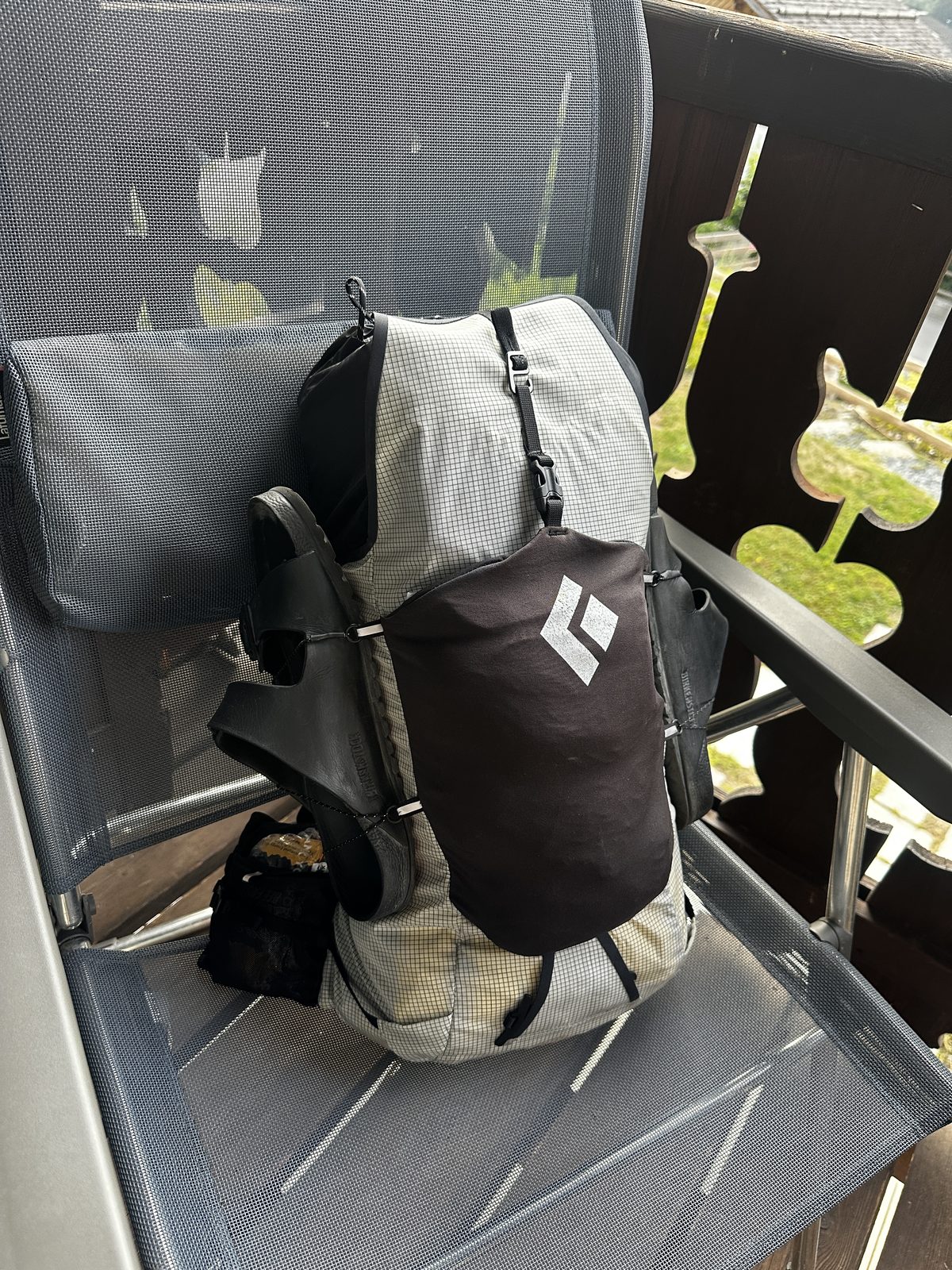
That's the whole thing, packed. Five days and four nights inside a 22L pack, with the Birkenstocks strapped to the outside because there was no chance they were fitting in there.
If you're going bigger than 22L plus a belt for a hut-to-hut trip, I'd look hard at what you're carrying before you look at a bigger pack.
Clothing
You're running the same clothes for five days. Accept that now.
The system is simple: one running kit that you wear, one spare of the things that matter, and one small set of clean clothes so you're not sitting in a refugio dining room in sweaty running gear.
- Rab Momentum running hat. Sun protection and something to dunk in a stream on the hot climbs.
- 2x sun shirts. The single best item on this list. Long sleeve sun shirts keep the sun off your arms and the back of your neck all day. Two means you always have a dry one. I don't do big mountain days without one anymore.
- 2x pairs of merino running socks. Two pairs, wash one, wear one. Merino because it dries overnight and doesn't stink after day two.
- Rab Talus 7-inch running shorts. One pair. You're washing them in a sink most nights anyway.
- Smith Wildcat sunglasses. You're above the treeline for hours at a time on snow and rock. Cheap sunglasses give you a headache by day three.
- Rab Phantom Shell. Weather in the Alps turns fast. It stays in the pack most of the time and then you're very grateful for it.
- Rab Nano Puff. For the cold mornings, cold passes, and sitting outside a refugio at 2000m watching the sun go down.
- Hut clothes: shirt, shorts, underpants, socks. A tiny set of clean, dry clothes for the evenings. Weighs almost nothing and makes the nights feel civilised.
- Topo Athletic Vistas. One pair, no spare. You want cushion on this route because the descents are long and relentless, and the accumulated damage over five days is what wrecks people, not any single day.
Do you need to carry more than one pair of shoes?
No. One pair of good, cushioned trail shoes did the whole route. A second pair is dead weight taking up space you don't have.
The thing that matters is that they're already broken in and you know how your feet behave in them after six hours. The TMB is not the place to test new shoes.
Hydration
- 1.5L total capacity across 3x 500ml soft flasks. Splitting it across three flasks means you can carry two in the front and one in the pack, and you can drink one dry without losing balance in the vest.
- Water filter. Honestly? I'd leave it at home next time. Water is readily available in basically every section of the TMB. Streams, taps, refugios, villages. I carried the filter for five days and barely used it.
Do you need a water filter on the Tour du Mont Blanc?
I took one and I didn't need it. Water is available almost constantly on the TMB, from streams, village taps and refugios, and 1.5L of capacity was plenty to get between sources.
If it makes you feel better, take one. It isn't heavy. But it's the first thing I'd cut if I was fighting for space in the pack.
Nutrition
This is where I got the strategy right, and it saved more space than any gear decision.
We stocked up in towns as we passed through them, and relied on refugios for lunch and dinner. Every time we hit a town we'd grab coffees and pick up snacks for the coming section. That meant I never had to carry more than a day or two of food.
- 15 servings of carb powder. Roughly three a day. This is the base of my fuelling and it goes straight into a flask.
- Circl Hydrate. My electrolyte. Long days in the sun at altitude means you're losing a lot more salt than you think, and this goes in a flask alongside the carbs.
- 15 BEE Fast honey energy gels. Three a day, for the climbs and the back half of each day when eating real food gets harder. Honey based, so they sit better in my stomach than synthetic gels on back-to-back days.
- Misc snacks. Bought as we went. Whatever the shop had.
- 2x dehydrated meals. Never got eaten. I took them for dietary reasons and it turned out the refugios were far more accommodating than I expected. Straight into the "leave at home" pile.
Do you need to carry food on the Tour du Mont Blanc?
Not much of it. The TMB passes through enough villages and refugios that you can eat properly almost every day without carrying meals.
What you do need to carry is your on-the-move fuelling: carb powder, gels, snacks. Refugio lunch is great but it doesn't help you at the top of a 1000m climb three hours after breakfast.
Buy food as you go. It's cheaper in space than it is in your pack.
Sleeping
Staying in refugios means you don't carry a sleeping bag. They provide blankets and bedding, but they require a liner.
- Sleeping bag liner. Required by most refugios. Non-negotiable.
- Pillow case. Small, light, and makes a shared dorm feel a bit less like a shared dorm.
That's it. That's the entire sleep system, and it's the biggest single reason a 22L pack is even possible.
Safety
The mountains don't care that you're running fast. You're crossing passes at altitude in weather that can turn in an hour, sometimes a long way from help.
- Thermal top, plus a spare. One to wear, one that stays dry no matter what.
- Thermal bottoms. For cold passes and cold refugio nights.
- Full first aid kit. Not a token one. Blisters, cuts, and the ability to actually deal with something on a mountainside.
- Safety blanket. Weighs nothing. Buys you hours if you or someone else is stuck and cold.
I didn't use any of it. That's the point. This is the category where you carry the weight and hope it stays in the bottom of the dry bag all week.
Miscellaneous
- Charging adaptor. European plugs. Obvious until you're standing in a refugio at 8pm realising you can't charge anything.
- Power bank and cables. Refugios have limited power points and a queue for them. The power bank means you're not fighting for one.
- Suunto running watch. Navigation, vert, and the daily numbers.
- Deodorant, toothbrush, toothpaste, sunblock. Sunblock is the one that matters most. You're at altitude, on snow, all day, for five days.
- Small towel. For refugio showers and washing kit in sinks.
- Passport. You cross between France, Italy and Switzerland.
- Debit card and cash. Some refugios and huts are cash only, or have unreliable card machines. Carry both.
What I'd leave behind next time
Two things.
The water filter, because water is everywhere on this route and I barely touched it. And the two dehydrated meals, because I didn't know how accommodating the refugios would be and it turned out they handled it without any fuss.
That's the whole list of regrets. Nothing else was dead weight.
The honest takeaway
I think we nailed the packing. There were a couple of things I'd leave behind now that I know how the refugios work, but there was nothing I was missing.
That's the bar for a trip like this. Not the lightest pack, not the most gear. Just getting to the end of five days without once thinking "I wish I'd brought that."
If you're planning the TMB as a fastpack, start from the refugio bookings and work backwards. The huts decide your pack size, not the other way around.
Enjoyed this? There's more where that came from.
From coaching services to gear recommendations — I've got you covered for your next ultra.